The Core Science: Ultimate-guide-intermittent-fasting-methodsAutophagy and Metabolic Flexibility
To appreciate the true value of intermittent fasting, it is helpful to look past simple calorie restriction and focus on two primary biological processes:
1. Autophagy (Cellular Cleanup)
When you enter an extended fasting window, your nutrient-sensing cellular pathways notice the lack of incoming energy. This triggers autophagy—a crucial process where cells break down, clear out, and recycle damaged proteins, old organelles, and dysfunctional cellular components. Think of it as a natural internal deep-cleaning system that protects tissues from premature aging and degeneration. Read Also: The best anti-inflammatory foods to Fight Joint Pain and Inflammation Naturally
2. Metabolic Flexibility
Most people depend entirely on a steady stream of glucose from carbohydrates to power their daily activities. Intermittent fasting trains your body to cultivate metabolic flexibility—the ability to seamlessly transition between burning glucose and burning fatty acids (and their byproduct, ketones). This metabolic shift preserves lean muscle tissue, stabilizes daily energy, and optimizes mitochondrial function.
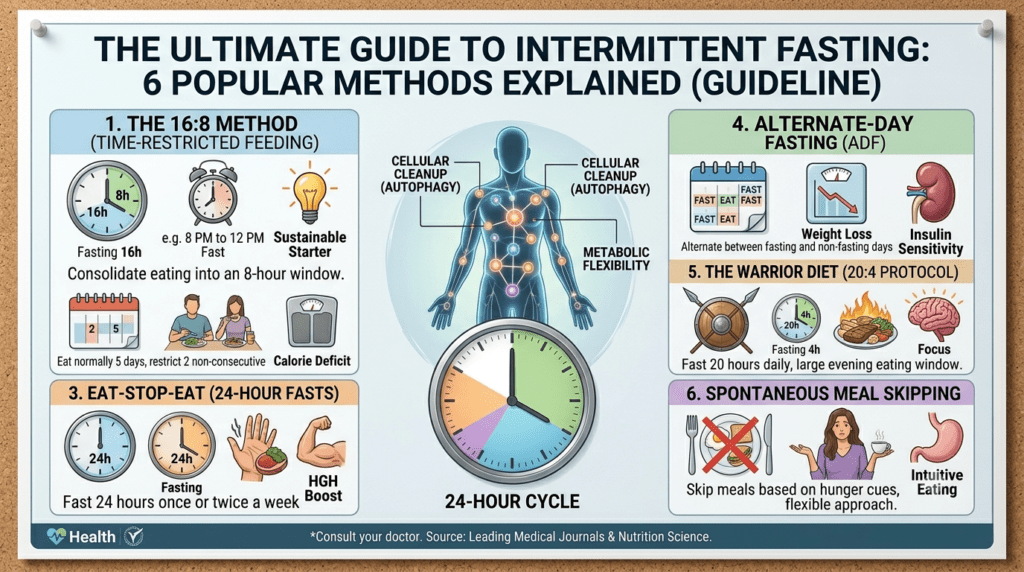
The 16:8 method is the most popular time-restricted feeding schedule globally, making it a great starting point for beginners. It involves fasting completely for 16 hours and consolidating your daily nutritional needs into an 8-hour eating window.
Example Schedule: Fast from 8:00 PM until 12:00 PM the following day, consuming all meals between noon and 8:00 PM.
Why it works: It is incredibly sustainable, fits naturally around standard sleep cycles, and effortlessly eliminates late-night mindless snacking.
2. The 5:2 Method (The Fast Diet)
The 5:2 method focuses on your weekly routine rather than daily hourly windows. Under this framework, you eat normally without calorie tracking for 5 days of the week. On the remaining 2 non-consecutive days, you restrict your total energy intake to roughly 500 calories for women and 600 calories for men.
Example Schedule: Eat normally every day except Tuesdays and Thursdays, where you consume one or two small, nutrient-dense meals.
Why it works: It provides a strong weekly caloric deficit without requiring daily restriction, making it highly effective for weight loss.
3. Eat-Stop-Eat (24-Hour Fasts)
Popularized by fitness researchers, the Eat-Stop-Eat protocol involves taking a complete 24-hour break from food once or twice a week. During the fasting window, no solid food is permitted, though calorie-free hydration is heavily encouraged.
Example Schedule: Eat dinner at 7:00 PM on a Monday, then fast completely until dinner at 7:00 PM on Tuesday.
Why it works: A full 24-hour fasting window allows liver glycogen levels to empty completely, triggering robust levels of autophagy and human growth hormone (HGH) production.
4. Alternate-Day Fasting (ADF)
Alternate-Day Fasting is a more rigorous protocol where you modify your schedule every other day. On fasting days, you either consume zero calories or limit yourself to a single 500-calorie meal. On the alternating days, you return to eating regular, unmeasured meals.
Example Schedule: Fast completely on Monday, eat normally on Tuesday, fast completely on Wednesday, and so on.
Why it works: Clinical studies demonstrate that ADF is exceptionally powerful for reducing visceral fat and improving insulin sensitivity markers in adults with metabolic syndrome.
5. The Warrior Diet (20:4 Protocol)
Inspired by ancient warrior eating patterns, this method features a strict 20-hour fasting window followed by a 4-hour evening feast. Adherers typically skip breakfast and lunch, spending the daytime hours in a heightened state of alertness driven by cortisol and adrenaline.
Example Schedule: Fast all day, then open your eating window from 4:00 PM to 8:00 PM with a large, nutrient-dense dinner.
Why it works: The extended 20-hour daily fast maximizes fat-burning pathways while allowing for highly satisfying, large meals at night.
6. Spontaneous Meal Skipping
If rigid schedules do not fit your lifestyle, spontaneous meal skipping is a flexible, intuitive alternative. You simply skip meals when you do not feel genuinely hungry or when you are short on time.
Example Schedule: Skipping breakfast on a busy morning or bypassing dinner after a large, late afternoon lunch.
Why it works: It breaks the psychological rule that you must eat multiple times a day out of habit, allowing your hunger hormones (like ghrelin) to guide your choices naturally.
Frequently Asked Questions (FAQs)
What can I drink during my fasting window?
To keep your insulin low and maintain your fasted state, stick to calorie-free options. Pure water, sparkling water, black coffee, and unsweetened green or herbal teas are all excellent choices. Avoid adding cream, milk, sugar, or artificial sweeteners, as these can disrupt fasting pathways and break autophagy.
Does intermittent fasting cause muscle loss?
No, provided you consume adequate protein during your designated eating windows and continue regular resistance training. Studies show that fasting actually increases human growth hormone (HGH), which helps protect lean muscle mass while your body burns body fat for energy.
Can women follow the same fasting protocols as men?
Women are often more sensitive to intense nutrient deprivation because fasting can impact signals to the hypothalamus. Extended, rigorous fasts can occasionally interfere with luteinizing hormone production. Women often see excellent results by taking a gentler approach, starting with a 14:10 schedule or using a relaxed 16:8 protocol.
Will fasting slow down my resting metabolism?
Short-term intermittent fasting (under 48 hours) actually increases your metabolic rate slightly due to a natural rise in noradrenaline. Your metabolism only starts to slow down during prolonged starvation states lasting several consecutive days.
Conclusion & Medical Disclaimer
Intermittent fasting is a powerful, flexible tool that helps you optimize your calorie restriction windows, experience the benefits of autophagy, and build long-term metabolic flexibility. Ultimately, the best fasting method is the one that aligns seamlessly with your schedule and lifestyle preferences.
Medical Disclaimer: The information shared in this article is meant strictly for educational and informational purposes. It is not intended to serve as medical advice or a substitute for professional diagnosis and treatment. Always consult with a primary care physician or a certified medical practitioner before starting an intermittent fasting regimen—especially if you have a history of disordered eating, are pregnant or breastfeeding, or are managing chronic conditions like type 1 or type 2 diabetes.







1 thought on “The ultimate-guide-intermittent-fasting-methods: 6 Popular Methods Explained”