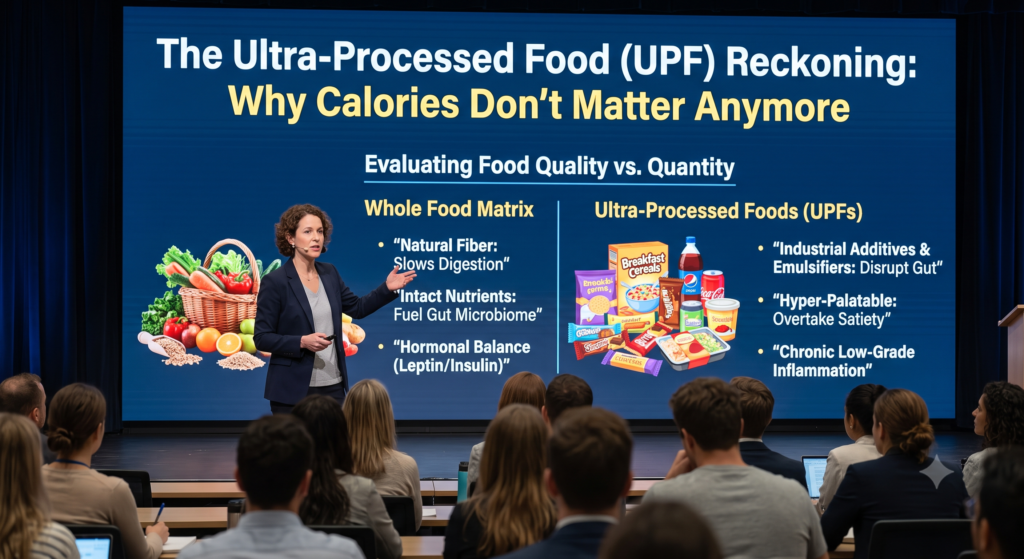
The Ultra-Processed Food Reckoning: Why Calories Don’t Matter Anymore
For the past several decades, global nutritional guidance has operated under a single, rigid mathematical formula: Calories In vs. Calories Out. Millions of health-conscious individuals spent their days logging macronutrients, scanning nutrition labels for low-fat markers, and choosing diet sodas over whole foods to fit within strict energy boundaries.
However, a massive paradigm shift is currently unfolding within the global health community. We are in the midst of a profound Ultra-Processed Food (UPF) reckoning. Emerging clinical data suggests that analyzing food solely by its caloric weight or basic macronutrient split is an outdated approach to metabolic longevity. The true culprit behind the global surge in metabolic dysfunction is not just the volume of food consumed, but the industrial alteration of the food matrix itself. Read Also: Muscle as a Metabolic Health Marker: The Ultimate Guide to Sarcopenia Prevention
To understand this shift, it is essential to define what actually qualifies as an ultra-processed food. The medical and scientific communities utilize the NOVA Classification System to categorize food into four distinct groups based on the extent of industrial processing:
Unprocessed or Minimally Processed Foods: Real, whole foods in their natural state (e.g., fresh vegetables, raw nuts, whole eggs, fresh meat).
Processed Culinary Ingredients: Substances derived directly from nature to help cook group 1 foods (e.g., olive oil, butter, honey, salt).
Processed Foods: Simple combinations of groups 1 and 2, typically made using traditional preservation methods (e.g., freshly baked artisanal bread, canned vegetables, simple cheeses).
Ultra-Processed Foods (UPFs): Industrial formulations made entirely from substances extracted or derived from foods (such as hydrogenated oils, modified starches, and protein isolates) combined with synthetic additives, emulsifiers, artificial flavorings, and colorings.
UPFs are specifically engineered by food scientists to achieve a state of hyper-palatability. By perfectly balancing levels of synthetic fats, refined sugars, and sodium, these industrial products bypass natural human satiety mechanisms, overriding the brain’s internal cues that signal full fullness.
The Lancet and BMJ Evidence: Beyond the Calorie
The shift away from basic calorie counting toward the UPF reckoning is strongly supported by high-impact medical research. Landmark publications in The Lancet and The BMJ have provided extensive epidemiological and mechanistic proof that heavy reliance on industrial formulations severely degrades human health across multiple organ systems.
Health Metric
Impact of High UPF Diet
Primary Scientific Source
Cardiovascular Disease
Up to a 50% increased risk of CVD-related mortality
The BMJ Umbrella Review
Metabolic Health
12% to 40%+ higher risk of incident Type 2 Diabetes
The BMJ / The Lancet
Gut Microbiome
Severe dysbiosis, loss of keystones, degraded mucosal barrier
The Lancet Series
Oncology Risk
Direct correlation with early-onset gastrointestinal & colorectal cancers
The BMJ / Clinical Cohorts
An extensive umbrella review published in The BMJ analyzed data covering millions of participants.The researchers found direct, convincing links between high exposure to ultra-processed foods and 32 distinct damaging health outcomes, spanning metabolic, cardiovascular, mental, and gastrointestinal health.Crucially, these elevated risks remained significant even when researchers controlled for total calorie intake and baseline obesity levels, proving that the processing itself causes unique physiological harm.
How UPFs Alter the Human Gut Microbiota
One of the primary mechanisms behind UPF-induced metabolic damage is the destruction of the human gut microbiome. Whole foods contain complex structural fibers and micronutrients that act as prebiotics, feeding beneficial bacteria like Akkermansia muciniphila and Bifidobacterium.
Ultra-processed foods lack this natural fiber matrix.Instead, they introduce high concentrations of chemical additives, including industrial emulsifiers (such as polysorbate-80 and carboxymethylcellulose) and non-sugar artificial sweeteners.
The Mechanism of Gut Erosion: Industrial emulsifiers function like detergents within the digestive tract. They alter the protective mucus layer lining the intestinal wall, allowing pathogenic bacteria to come into direct contact with epithelial cells. This degradation results in increased intestinal permeability—a clinical state commonly referred to as leaky gut.
As the gut barrier thins, bacterial toxins known as lipopolysaccharides (LPS) leak directly into the bloodstream. This triggers a state of low-grade chronic systemic inflammation. This constant immune activation directly damages insulin receptors on cell surfaces, causing systemic insulin resistance and accelerating the onset of metabolic syndrome.
From Gut Inflammation to Chronic Disease
The systemic inflammation caused by a UPF-dominant diet serves as a foundational driver for the world’s most common non-communicable chronic illnesses:
Type 2 Diabetes: The rapid absorption of highly refined carbohydrates in UPFs causes dramatic blood glucose spikes.When paired with additive-driven systemic inflammation, pancreatic beta cells face progressive exhaustion, leading to a breakdown in glucose regulation.
Cardiovascular Disease: Refined industrial vegetable oils high in omega-6 fatty acids undergo significant oxidation during high-heat manufacturing. These oxidized lipids, alongside elevated systemic inflammation, accelerate plaque formation within the arterial walls, significantly raising the risk of myocardial infarctions and ischemic strokes.
Oncological Risks:The Lancet Series highlights a concerning trend regarding early-onset cancers, particularly within the gastrointestinal tract.The presence of carcinogenic chemical compounds generated during ultra-processing, combined with an altered gut microbiome and damaged immune tracking, creates an environment where malignant cells can replicate more easily.
Reclaiming Health: Shifting Focus to the Whole Food Matrix
To counteract the effects of ultra-processing, health guidance must shift away from abstract calorie counting toward protecting the natural food matrix. The food matrix refers to how nutrients, fiber, and bioactive compounds are physically structured together in nature.
When a person consumes a whole piece of fruit or unrefined whole grain, the intrinsic fiber slows down nutrient absorption, preventing insulin spikes and directly nourishing deep colonic bacteria. When that same food is industrially stripped down to basic sugars and starches to manufacture a commercial snack bar, the protective matrix is permanently destroyed.
Reclaiming metabolic health requires choosing foods that undergo minimal alteration between nature and consumption. Emphasizing diverse plants, quality whole proteins, and unrefined natural fats provides the body with the complex bio-information it needs to regulate appetite naturally, restore gut barrier function, and lower chronic systemic inflammation.
Clinical FAQs
What is the simplest way to identify an ultra-processed food?
If a food package contains ingredients that you would not typically find in a standard home kitchen—such as high-fructose corn syrup, hydrogenated oils, soy protein isolate, emulsifiers, or artificial flavor enhancers—it is classified as an ultra-processed food.
Can a food be low in calories but still be ultra-processed?
Yes. Many diet products, zero-sugar sodas, and low-calorie packaged snacks are highly ultra-processed.While they may fit within a daily calorie budget, their synthetic additives and lack of structural fiber can still disrupt gut health and promote metabolic dysfunction.
Are all processed foods bad for human health?
No. Processing exists on a spectrum.Minimally processed or traditionally processed foods—like plain Greek yogurt, canned tomatoes, frozen unseasoned vegetables, and artisanal sourdough bread—retain their beneficial food matrices and can form part of a health-promoting diet.
Strategic Conclusion
The global ultra-processed food reckoning challenges the conventional belief that all calories are created equal.Robust scientific evidence from The BMJ and The Lancet demonstrates that the industrial manipulation of modern food directly disrupts the gut microbiome, driving the global rise in cardiovascular disease, type 2 diabetes, and early-onset cancers.Prioritizing whole foods over hyper-palatable industrial options allows individuals to look beyond simple caloric tallies and build lasting, structural metabolic health.
Medical Disclaimer
Disclaimer: The information provided in this article is intended strictly for educational and informational purposes. It does not constitute formal medical advice, diagnosis, or treatment. Always consult with a qualified physician or licensed healthcare provider regarding any changes to your diet, medical regimen, or management of a chronic health condition.







1 thought on “The Ultra-Processed Food (UPF) Reckoning: Why Calories Don’t Matter Anymore”